Mastering Audio Mixing: Techniques, Tools, and Creative Strategies for Producers & Engineers
In the world of music production, audio mixing stands as a critical bridge between raw recordings and polished masterpieces. Whether you’re working in a professional studio or crafting beats from your home setup, the art of mixing determines how listeners experience sound.
This guide delves deep into the science and creativity behind audio mixing, exploring everything from foundational principles to advanced workflows used by industry professionals. Readers will gain practical insights applicable across genres and production environments.
The Fundamentals of Audio Mixing
Mixing involves combining individual tracks into a cohesive stereo image while maintaining clarity and balance. It requires both technical knowledge and artistic intuition to achieve optimal results.
A typical mix session begins with organizing tracks logically, grouping similar instruments together for easier management. Proper track labeling and color-coding become essential habits during complex projects.
The human ear perceives sound in three dimensions: left-right positioning, front-back distance, and vertical height. Understanding spatial perception guides decisions about panning and reverb application.
Dynamic range control remains central to mixing, balancing loud and quiet passages through compression and automation. Maintaining natural dynamics prevents over-processing that dulls musicality.
Essential Equipment and Software Tools
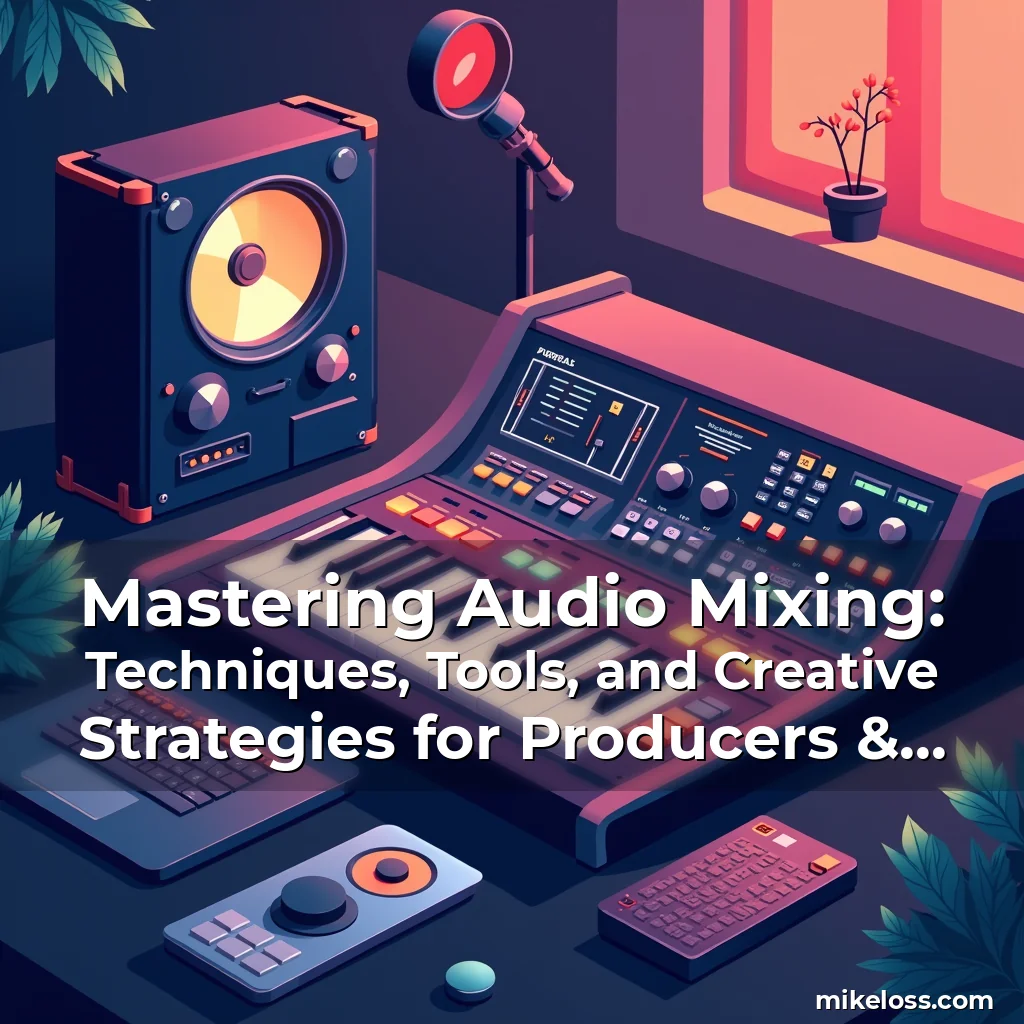
Modern mixing relies heavily on digital audio workstations (DAWs), which offer virtual mixing consoles with unlimited channel strips and effects processing capabilities.
Digital Mixers: Hardware controllers like the Allen & Heath Xone:96 or Mackie Onyx Blackjack provide tactile feedback alongside software integration. Analog-style faders and knobs enhance workflow efficiency.
Virtual Instruments: Plugins such as Native Instruments Komplete and Arturia V Collection expand sonic possibilities beyond standard sample libraries. Synthesizers, drum machines, and orchestral emulations populate modern mixes.
Monitoring Systems: High-quality speakers like Yamaha HS8 or KRK Rokit series deliver accurate frequency response. Studio headphones such as Sennheiser HD 600/650 remain indispensable for critical listening sessions.
Crafting a Balanced Frequency Spectrum
Frequency analysis forms the backbone of effective mixing. Using spectrum analyzers reveals conflicting frequencies that cause muddiness or harshness in the mix.
EQ adjustments follow a systematic approach: boost problem areas This method preserves signal integrity.
High-pass filters: Applying high-pass filtering to non-low-frequency sources removes unnecessary rumble and clears space in the bass register. Typical cutoffs range from 80Hz to 200Hz depending on the instrument.
Low-shelf boosts: Subtle low-end enhancements (around +1dB to +3dB) add warmth to vocals and acoustic guitars without compromising punchiness. Overuse leads to muddy mixes.
- Bass Management: Kick drums often compete with bass guitar frequencies. Phase alignment and parallel compression techniques help achieve separation without sacrificing impact.
- Vocal Clarity: Surgical EQ cuts around 250Hz-500Hz reduce boxy resonance, while gentle shelving above 10kHz adds airiness. De-essers target sibilance without affecting vocal character.
Panning and Spatial Arrangement
Strategic panning creates width and dimensionality in stereo mixes. Rather than defaulting to extreme positions, subtle placement enhances natural imaging.
Instrumental spacing follows conventional wisdom: rhythm section typically occupies center-left/right, while lead melodies sit slightly off-center. Panned synths and ambient textures occupy outer edges.
Stereo Imaging Plugins: Tools like iZotope Ozone Imager or Waves S1 Stereo Imager allow precise width adjustment. Some engineers apply slight widening during tracking to simplify mixdown.
However, over-widening risks phase cancellation when played back on mono systems. Always check mixes on various playback devices to ensure compatibility.
Compression and Dynamics Control
Compression shapes dynamic range by reducing volume peaks while allowing quieter signals to pass unimpeded. Attack/release settings determine how quickly compressor reacts to transients.
Knee Type Selection: Soft knees provide smoother transitions, ideal for vocals and strings. Hard knees create more aggressive limiting suitable for percussion and mastered material.
Parallel compression (also known as New York style) blends compressed and dry signals to retain original dynamics while adding sustain. Commonly applied to buses and overhead microphones.
RMS-based compressors react to average levels whereas peak-based units respond to transient spikes. Choosing appropriate metering modes affects perceived loudness consistency.
Reverberation and Ambience Design
Reverb transforms flat sounds into spatial experiences. Different room sizes and decay times dramatically alter the sense of environment and intimacy.
Room Types: Small rooms (decay < 1sec) suit intimate settings; medium spaces (<2secs) work for most applications; large halls (>3secs) evoke grandeur but risk overwhelming smaller elements.
Tailoring reverb characteristics to source materials maintains clarity: plate reverbs complement vocals and piano, while convolution reverb captures real acoustic spaces accurately.
Early reflection controls shape initial reflections’ density, affecting perceived proximity. Late reverb tail length determines overall spaciousness without losing definition.
Automation and Time-Based Effects
Manual automation allows precise control over volume, pan, send levels, and effect parameters throughout the song timeline. Modern DAWs support lane-based editing for efficient parameter manipulation.
LFO modulation introduces movement to static sounds, particularly useful for synth pads and atmospheric textures. Rate/frequency settings dictate how fast modulation occurs.
Time-based effects include delay, chorus, flanger, and phaser. Delay repeats echoes at set intervals; chorus modulates pitch subtly creating thicker sound; flangers produce sweeping metallic tones.
Phasers sweep through filter banks, generating distinctive swirling patterns. Used creatively on guitars, synths, and lead vocals for added interest without overpowering.
Mastering vs. Mixing Distinction
While related, mixing and mastering serve different purposes. Mixing focuses on arranging individual tracks into a balanced stereo field, whereas mastering prepares the final product for distribution.
Mastering engineers apply subtle equalization, light compression, and dithering to optimize loudness standards across platforms. Their goal is to preserve the artist’s intent while enhancing overall cohesion.
Some producers combine both roles, though separating duties often yields better results due to differing perspectives required for each stage. Reference tracks help assess progress objectively.
Proper level normalization ensures consistent output. Mastered tracks typically hover around -6dBFS to -3dBFS to accommodate platform-specific limitations without clipping.
Common Challenges in Professional Mixing
Muddled midrange frequencies frequently plague rock/metal mixes where guitars, keyboards, and vocals overlap significantly. Careful EQ sculpting becomes imperative in these situations.
Over-reliance on saturation plugins can mask underlying problems in recordings. While analog modeling adds warmth, it shouldn’t replace fundamental fixes like tuning and timing correction.
Phase coherence issues arise when multiple microphone setups capture same source from different angles. Mid-side processing helps align polarities effectively.
Loudness wars continue influencing mixing approaches despite audiophile criticisms. However, transparent mastering techniques now prioritize dynamic range preservation over sheer volume.
Creative Strategies for Unique Sounds
Experimentation lies at heart of innovative mixing. Unconventional techniques yield distinctive sonic signatures recognizable in popular music today.
Mid/side processing enables independent control over center and side channels. This technique reshapes stereo images without disrupting core elements excessively.
Mono compatibility checks reveal potential weaknesses in stereo arrangements. Testing mixes on mono speakers identifies problematic phase cancellations early.
Reverse engineering favorite tracks provides insight into legendary mixes. Analyzing bus routing, plugin chains, and automation patterns offers learning opportunities.
The Future of Audio Mixing Technology
Artificial intelligence increasingly influences audio post-production processes. Machine learning algorithms analyze frequency spectrums and suggest optimal EQ settings automatically.
Immersive audio formats like Dolby Atmos and MPEG-H demand new approaches to spatial arrangement and object-based mixing techniques. Traditional stereo paradigms evolve continuously.
Cloud collaboration tools enable remote mixing sessions among geographically dispersed teams. Version control systems manage changes efficiently during collaborative projects.
Augmented reality interfaces visualize audio data in 3D space, offering novel ways to manipulate soundscapes intuitively. Early prototypes show promising interaction models.
Conclusion
Audio mixing represents both an exact science and profound art form requiring continuous study and experimentation. Mastery demands patience, technical proficiency, and creative vision aligned with project goals.
To elevate your skills, consistently listen critically to diverse references, experiment with unconventional methods, and stay updated with evolving technologies shaping the industry landscape. Your dedication to craft ultimately defines the quality of your mixes.